Impact Report: Transforming Futures Through Science Education in Kenya
Background
The COR Mariae Schools are managed by the Sisters of the Immaculate Heart of Mary Mother of Christ in Kiambu, Kenya. Situated within tea and coffee plantations, the school serves a deeply vulnerable student population. Many of its students are street children, orphans, or dependents of local plantation workers who struggle with low, seasonal wages and high rates of poverty.
Guided by a mission to provide holistic, practical education, the Sisters equip students with essential academic knowledge and basic life skills, empowering them to break the cycle of poverty and lead change within their community. Despite having the capacity to accommodate 1,500, enrollment stood at just 250 students due to local financial hardship and families transferring children elsewhere in search of better educational resources.
Challenge
A major hurdle facing the school was the high cost of educational equipment, particularly for science curriculum requirements and national examinations. Without an equipped science laboratory, students were forced to learn complex scientific concepts strictly from textbooks. The lack of practical application left many students feeling disengaged and convinced that quality education was reserved for the wealthy.
Furthermore, the absence of practical learning facilities led to low daily attendance, underperformance in key subjects, and a continuous drop in enrollment as parents transferred their children to better-equipped institutions—even when those facilities were miles away and financially out of reach. To prepare students for national exams, foster technological literacy, and improve overall academic quality, the school urgently needed to establish a functional science laboratory and acquire basic tech equipment.
Solution
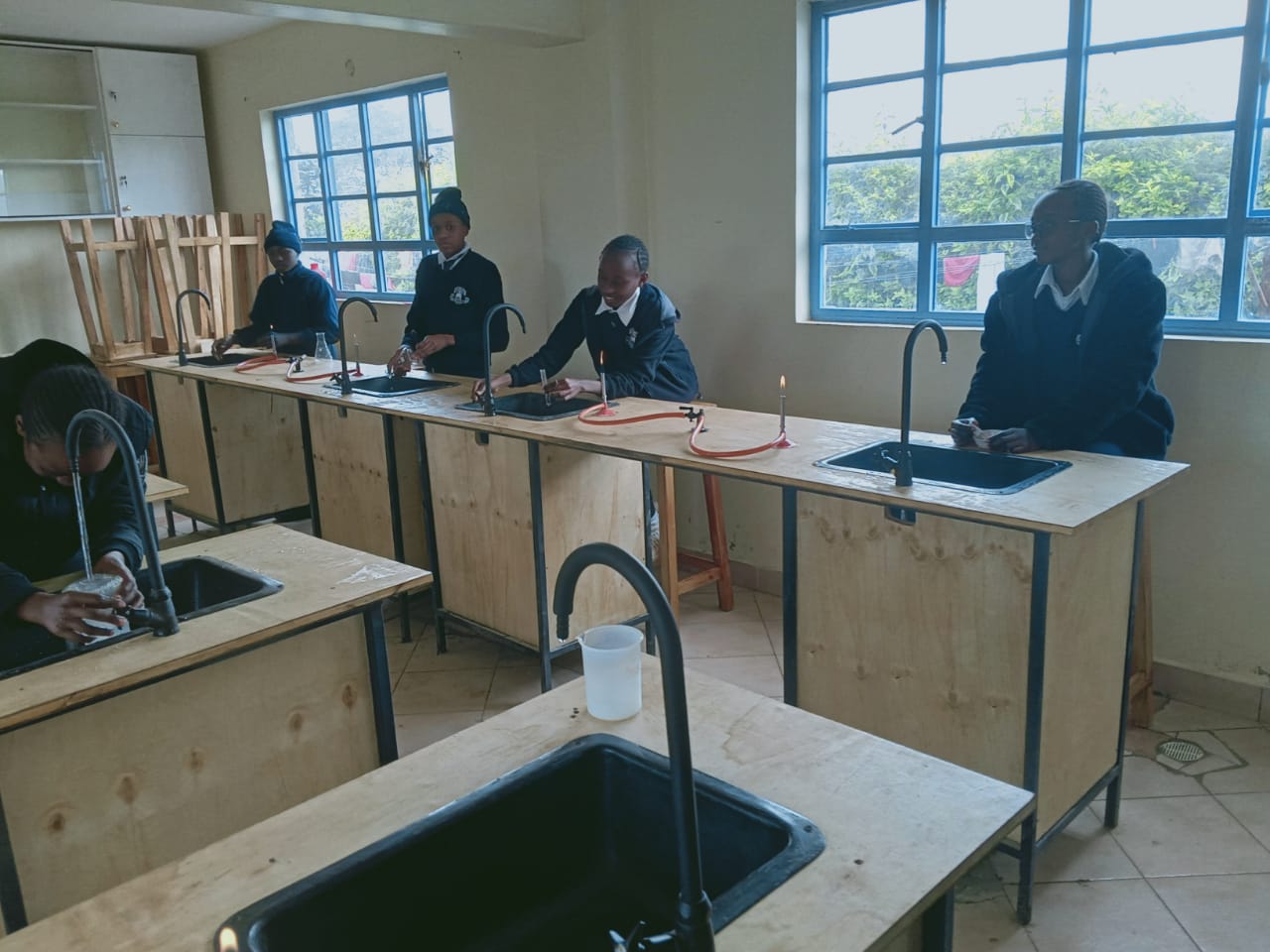
With an SRW grant, COR Mariae Schools executed a comprehensive plan to build and furnish a fully operational science laboratory. The funds were specifically allocated toward:
- Purchasing and installation of laboratory tables, stools, a blackboard, reagents, chemicals, and specialized science equipment.
- Installing essential utility infrastructure, including plumbing, water taps, and electrical fixtures.
- Integrating daily practical lab work into the curriculum, supervised by teaching staff to ensure safe and regular hands-on learning.
The practical laboratory immediately transformed how science was taught, enabling students preparing for National Exams to perform individual and group experiments regularly. The school also leveraged the lab to engage the broader community by launching a "Community Science Day," where students demonstrated practical solutions, such as testing household water safety to local families. Students also visited nearby primary schools to conduct basic science demonstrations for younger children.
Results
The installation of the science laboratory created immediate, measurable improvements across both the school and the surrounding community:
- Increased Enrollment and Retention: Enrollment grew from 250 to 350 students, with many re-enrolling after previously leaving due to insufficient educational resources.
- Improved Attendance and Academics: Access to hands-on experiments reignited students' enthusiasm for learning, leading to higher daily attendance, greater classroom focus, improved performance, and renewed aspirations to pursue medical and scientific careers.
- Community and Household Impact: Parents gained confidence in the school’s quality of education. Through student-led home demonstrations, educational benefits extended directly into local households, strengthening bonds between the community and the institution.
Parent Testimonial:
"Before receiving this grant, my child had never seen science laboratory equipment, reagents and even chemicals... Now, thanks to the science laboratory and equipment funded by this grant, my son visits the school lab daily to learn how to carry out different practicals individually or even as a group. This has transformed our lives... and given my child a chance at a brighter future."
— Alice W.